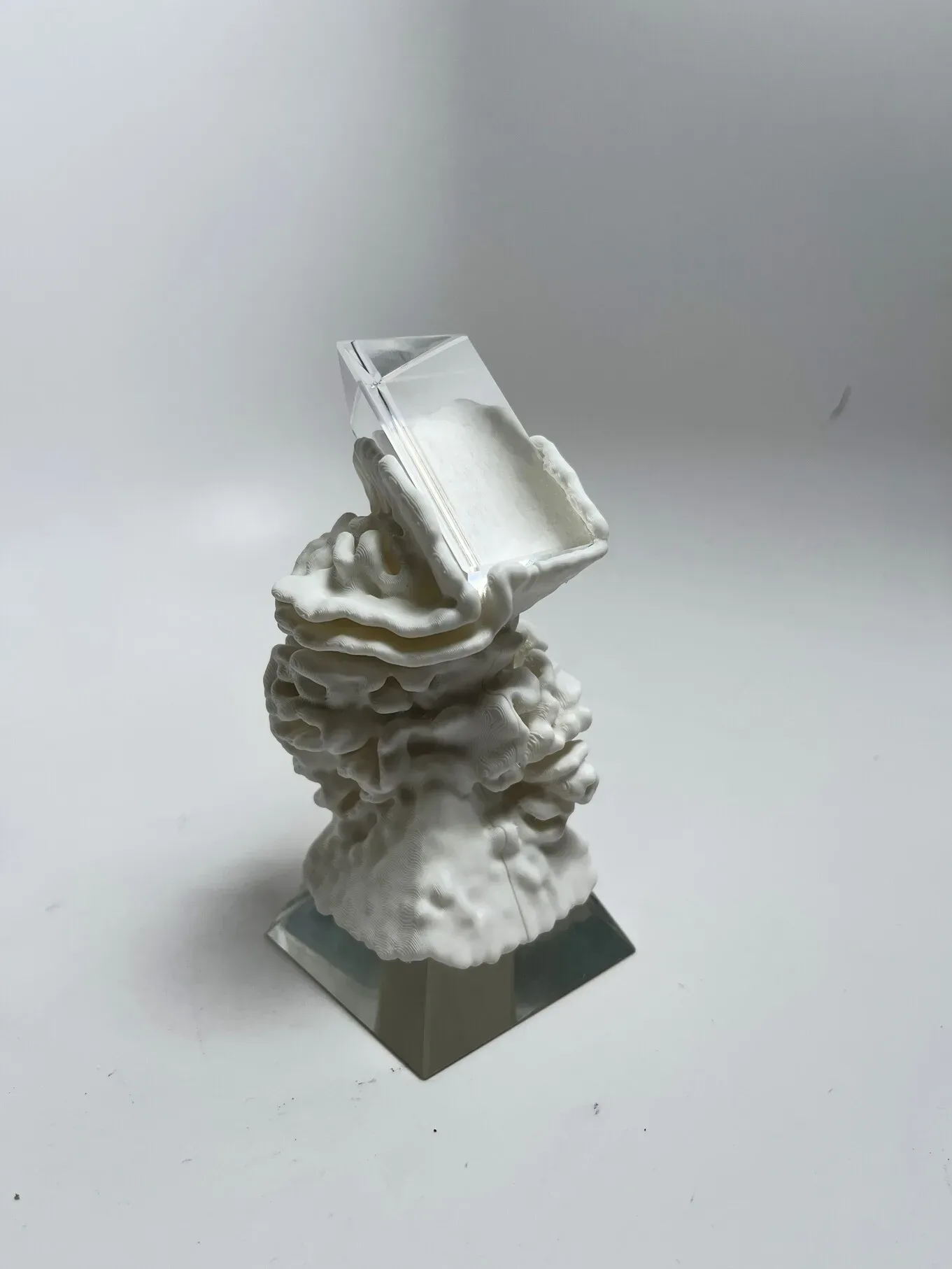
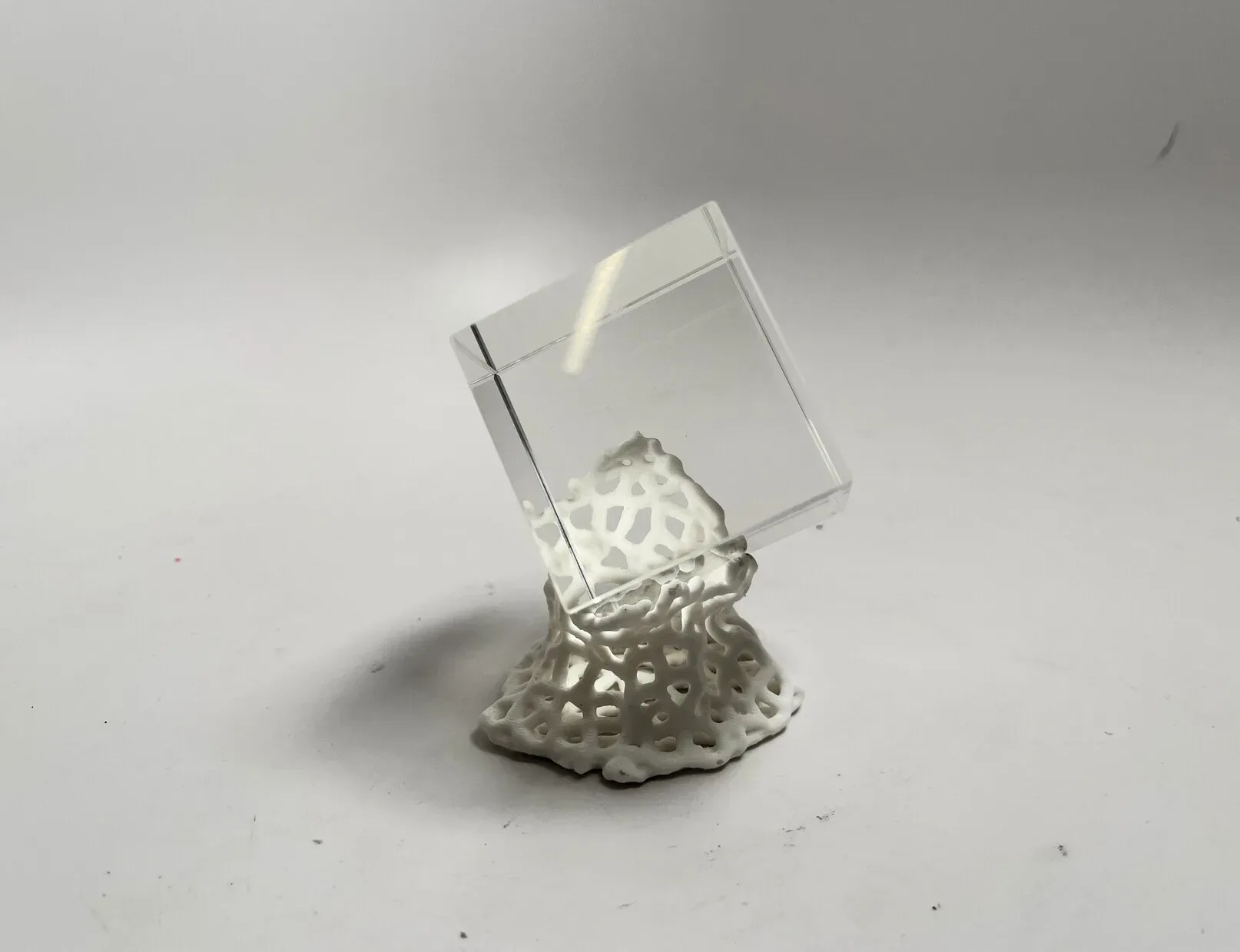
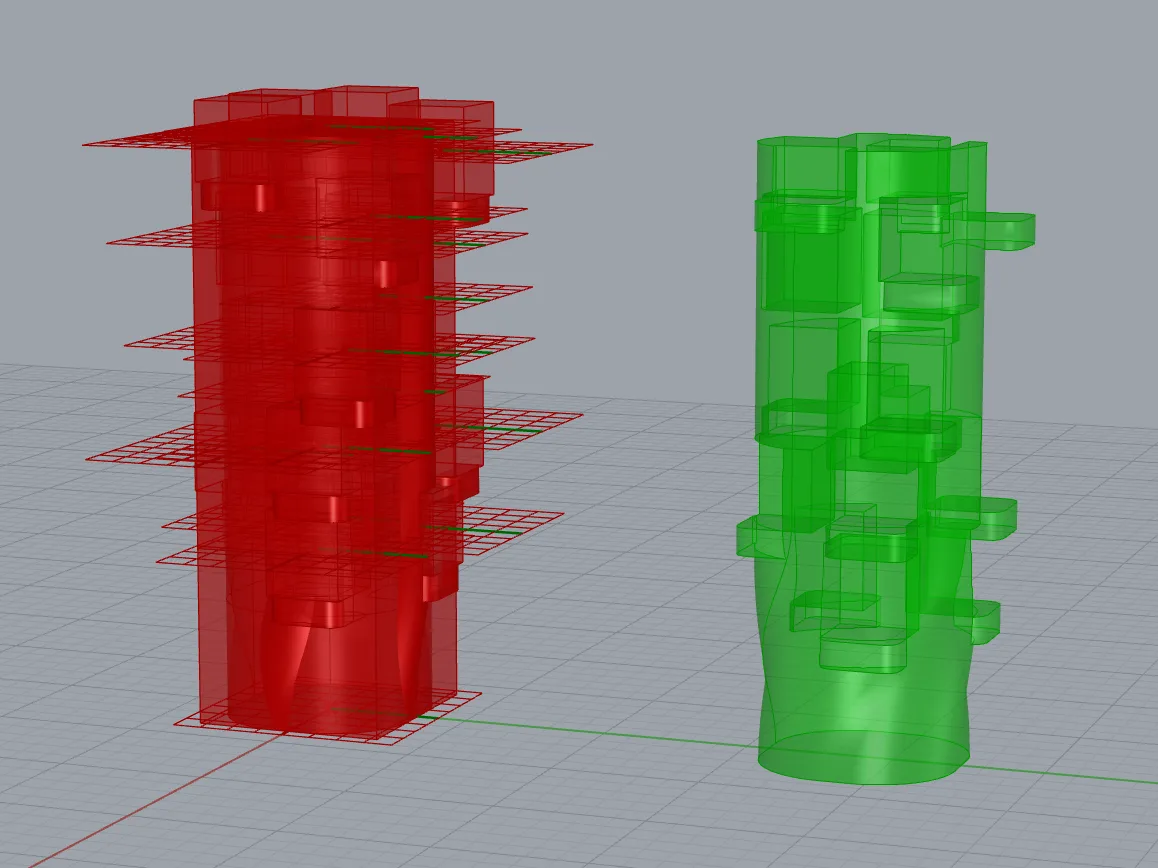
I fabricated 3D printed sculptures from the output of a differential growth simulation that grows organic forms directly around rigid glass shapes without manual intervention.
The final geometry is shaped entirely by simulated forces: vertices push outward along their normals, accelerate along curvature ridges, get nudged by 4D Perlin noise, pull toward attractor points, and raycast against the glass to detect collisions and grow around it. Built in Blender Geometry Nodes, the simulation remeshes the geometry into a consistent voxel volume every frame, inserting new points automatically as the form expands and keeping resolution even no matter how much it’s grown. I’d been wanting to fabricate a “frozen” simulation of some kind, and landed on differential growth, inspired by Brian Knep’s algorithmic ceramics and Michael Hansmeyer’s computational architecture.
Every parameter (voxel size, force multipliers, noise scale and power, attractor strength) is exposed for real-time tuning, which is how three sculptures came out of the same system with very different characters: Dual Prisms (aggressive branching from high curvature, high noise, and dual attractors), Cube (smoother wrapping from lower curvature and larger voxels, finished with a voronoi shell post-process), and Coral (unconstrained organic branching from maxed-out noise with no attractors). All three were printed in matte white PLA and fitted around their glass primitives, Dual Prisms split into two parts with a boolean joint for printability, while the coral forms needed careful support tuning to print clean.